
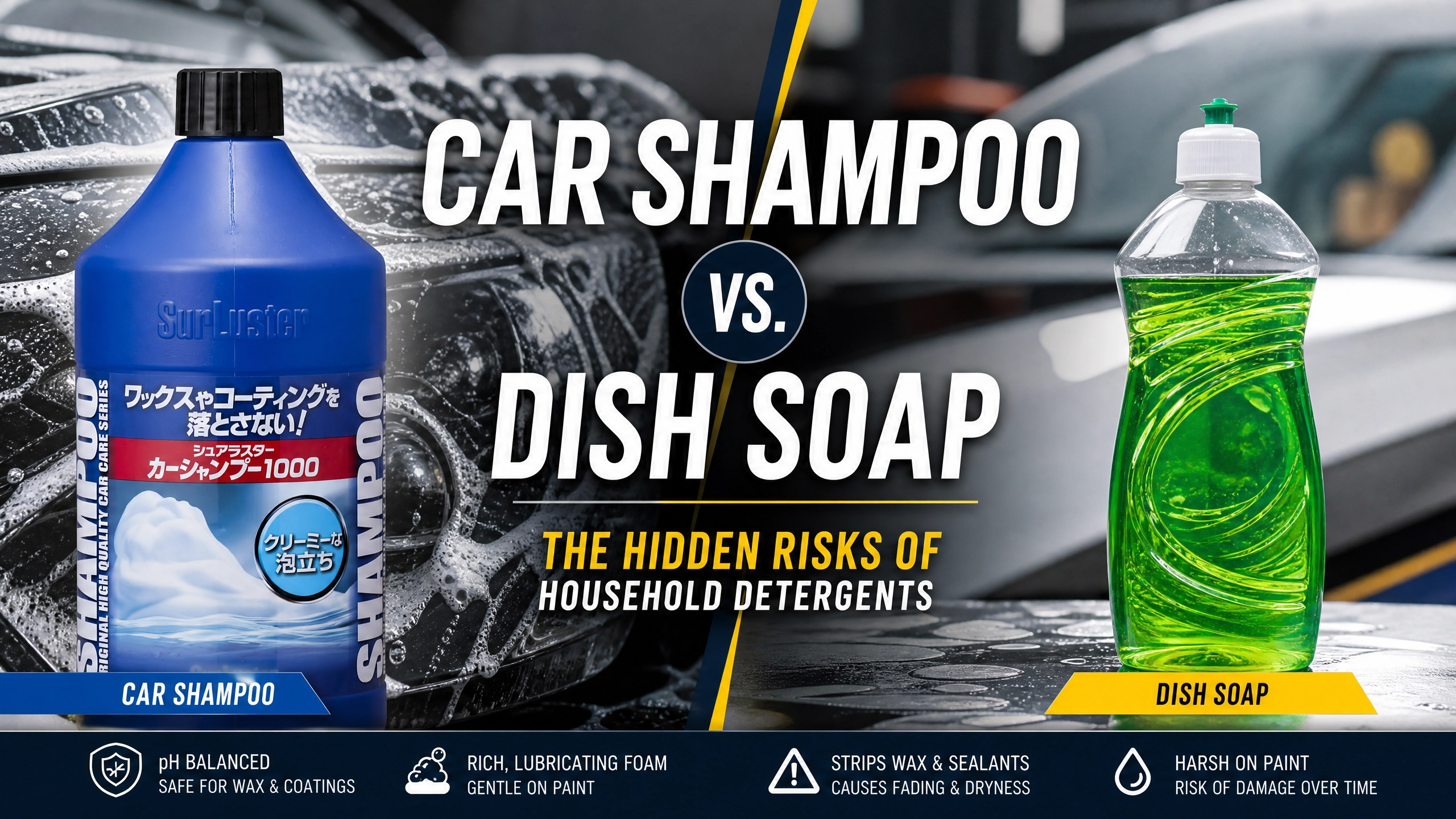
Have you ever wondered if you can substitute your regular kitchen dish soap for dedicated car shampoo when washing your vehicle? At first glance, it seems like a cost-effective and space-saving alternative. After all, both are liquid cleaning agents that generate rich suds. However, for vehicle owners who truly care about maintaining their car’s longevity and pristine appearance, using dish soap is highly discouraged. In this article, we dive deep into the chemical differences, pH levels, and specific characteristics of these two detergents to explain why dedicated car shampoo is irreplaceable.
Core Ingredients and Characteristics: Car Shampoo vs. Dish Soap
Whether it is formulated for automobiles or kitchenware, the primary active ingredient in most liquid detergents is the surfactant. Surfactants are versatile compounds found not only in cleaning agents but also in hair shampoos and body washes. However, surfactants vary greatly in type and intensity, ranging from powerful industrial cleansers to ultra-mild, skin-safe formulations.
A surfactant molecule naturally possesses a dual-nature structure: a hydrophilic (water-loving) head and a lipophilic (oil-loving) tail. This unique configuration allows it to clean surfaces through three synchronized actions:
- Penetration: Reducing the surface tension of water to allow it to penetrate deeply into the grime.
- Emulsification: Lifting oily stains off the surface and locking them away into the water molecules.
- Dispersion: Breaking down the detached dirt particles and scattering them evenly throughout the water to prevent them from settling back onto the surface.
The Crucial Role of pH Levels
The chemical behavior of a surfactant is determined by its pH (potential of Hydrogen) value, measured on a scale from 0 to 14. A pH around 7 is considered neutral, while anything below 7 is acidic, and anything above 7 is alkaline.
Strongly acidic detergents excel at dissolving calcified mineral deposits, water spots, and scale build-up. Conversely, highly alkaline detergents possess exceptional power against heavy grease and organic compounds. Neutral detergents, sharing the same pH level as pure water, have virtually no harsh chemical reactivity, making them exceptionally gentle on materials. Therefore, neutral cleansers are the ideal choice for routine car washing, as they safely remove daily surface dust and fresh grime without causing chemical damage to the car’s exterior paint or protective clear coat.
Why Using Dish Soap for Car Washing is Not Recommended
While substitution might seem practical, dish detergents are fundamentally engineered for a completely different purpose than automotive cleaners. The root cause of the problem lies in the nature of the dirt they are designed to fight.
The residue found on kitchen plates consists almost entirely of heavy food fats and cooking oils. To counter this, dish soap relies on aggressive, high-degreasing surfactants that immediately strip away stubborn oils. Additionally, to ensure kitchen chores are finished quickly, these soaps contain ingredients designed for rapid rinsing, meaning they lose their lubricity and sudsing power very fast once exposed to excessive water.
⚠️ The Hidden Risks of Dish Detergent on Automotive Parts: If you apply dish soap directly to your vehicle, its high-degreasing power will strip away critical defensive components. It will severely degrade vital rubber elements, including tires, door weatherstrips, window sealants, and exterior plastic moldings. Over time, this accelerated stripping leads to drying, cracking, and eventual water leaks. The risk multiplies significantly on older or classic vehicles where the rubber elements have already begun to weather.
The Superior Engineering of Dedicated Car Shampoos
In stark contrast, professional car shampoos are meticulously engineered to respect the intricate materials used in modern automobiles. Rather than relying on raw chemical stripping power, car shampoo focuses on creating an ultra-fine, creamy foam cushion.
This thick layer of foam acts as a physical barrier that encapsulates abrasive particles like sand, grit, and dust, lifting them safely off the paintwork. This cushion allows your wash mitt or sponge to glide effortlessly across the body, drastically minimizing the micro-scratches and swirl marks that dull a vehicle’s finish over time.
Quick Comparison
| Feature / Property | Dedicated Car Shampoo | Kitchen Dish Soap |
| Primary Target Dirt | Road dust, mud, environmental fallout, pollen | Heavy food fats, cooking oils, animal grease |
| Foam Characteristics | Thick, creamy, long-lasting lubricating cushion | Quick-breaking, low-lubricity suds optimized for fast rinsing |
| Impact on Rubber & Seals | Gentle and non-reactive; preserves elasticity | Aggressive degreasing; strips essential oils, causing cracks |
| Paint Protection Safe | Yes; preserves pre-existing waxes and coatings | No; completely strips away protective wax and sealant layers |
| Specialized Additives | Anti-rust agents, gloss enhancers, hydrophobic polymers | None (often includes skin-moisturizing agents unsuitable for cars) |
Furthermore, premium automotive shampoos go beyond basic surface cleaning. Many advanced formulas incorporate specialized anti-rust inhibitors to shield hidden metal seams from corrosion. Others contain sacrificial gloss agents or synthetic polymers that seamlessly replenish existing wax and ceramic coatings during the wash cycle itself. These protective benefits are completely absent in household dish detergents.
Conclusion: Protect Your Investment with the Right Products
While the convenience of using a single bottle of household soap for multiple tasks is tempting, the long-term cost of replacing degraded rubber seals, restoring stripped paintwork, and correcting unsightly swirl marks far outweighs the minor savings. To keep your vehicle looking showroom-fresh, maintaining its resale value, and ensuring its protective layers remain intact, always choose a premium, dedicated automotive formula like SurLuster’s range of car shampoos. Your vehicle deserves the specialized care that only automotive engineering can provide.
